Lasagna
luh-ZAHN-yuh
Also known as lasagne, doppio festone, sciabò, sciablò, bardele, lasagnoni, lasagna a nastro.
What it is
Lasagna may be the oldest pasta shape with a paper trail. A flat dough sheet called lagana appears in Roman sources, and medieval Italian writers picked up the thread. A Bolognese text of 1282 mentions lasagne, and Salimbene di Adam's 1284 chronicle records lagana cum caseo, sheets eaten with cheese. The first real recipe arrives in the early 14th century Liber de Coquina, which describes fermented dough rolled thin, boiled, layered with cheese and spices, and eaten with a small pointed stick. De Cecco's copy claims the name took hold after the year 1000, an attribution rather than a documented fact. For centuries the dish meant boiled sheets dressed with cheese, spices, or broth. Tomato versions now treated as standard are a 19th century development. Two traditions share the modern shape: Emilia-Romagna, where thin egg dough is rolled by hand, and the Naples area, where dried semolina sheets with ruffled edges anchor the Carnival lasagne.
The root is contested. Etymonline and Wiktionary trace lasagna through Vulgar Latin lasania to Latin lasanum, a cooking pot, from Greek lasanon, a trivet or pot stand, while a rival derivation reported by Wikipedia points to Greek laganon, a flat sheet of dough cut into strips. Wiktionary records a minority theory from Arabic lawzinaj, an almond cake.
What sauce it wants, and why
A lasagna sheet is less a noodle than a building material. Its flat, wide profile creates stable strata, so a baked dish holds clean layers of pasta, sauce, and cheese instead of collapsing into a stew. Thin sheets matter because each forkful cuts through several layers at once. Sauces should be moist and spoonable, since dried sheets, especially no-boil ones, drink liquid as they bake. Ruffled riccia edges trap extra ragu and crisp at the pan's rim. Slow meat sauces and besciamella work because they cling and settle rather than run.
Classic plates: lasagne alla bolognese, lasagne di Carnevale, pasticcio di lasagna.
No lasagna? Use these
Closest swaps by sauce behavior, not by looks. The ones most easily confused with lasagna, and how they read.
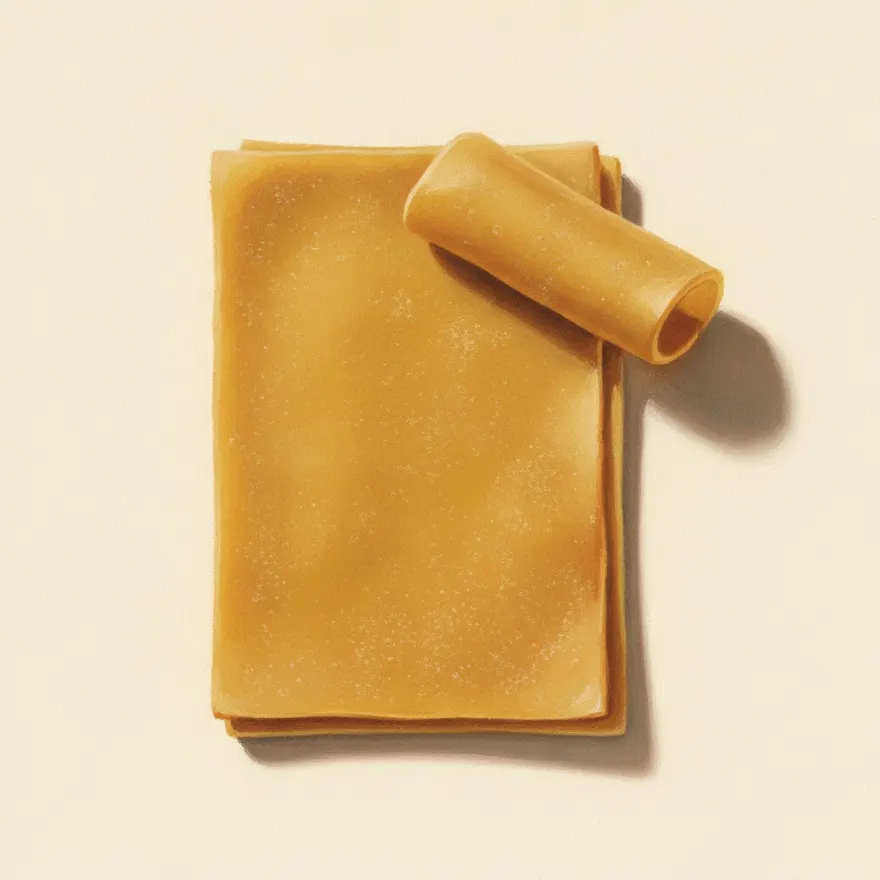
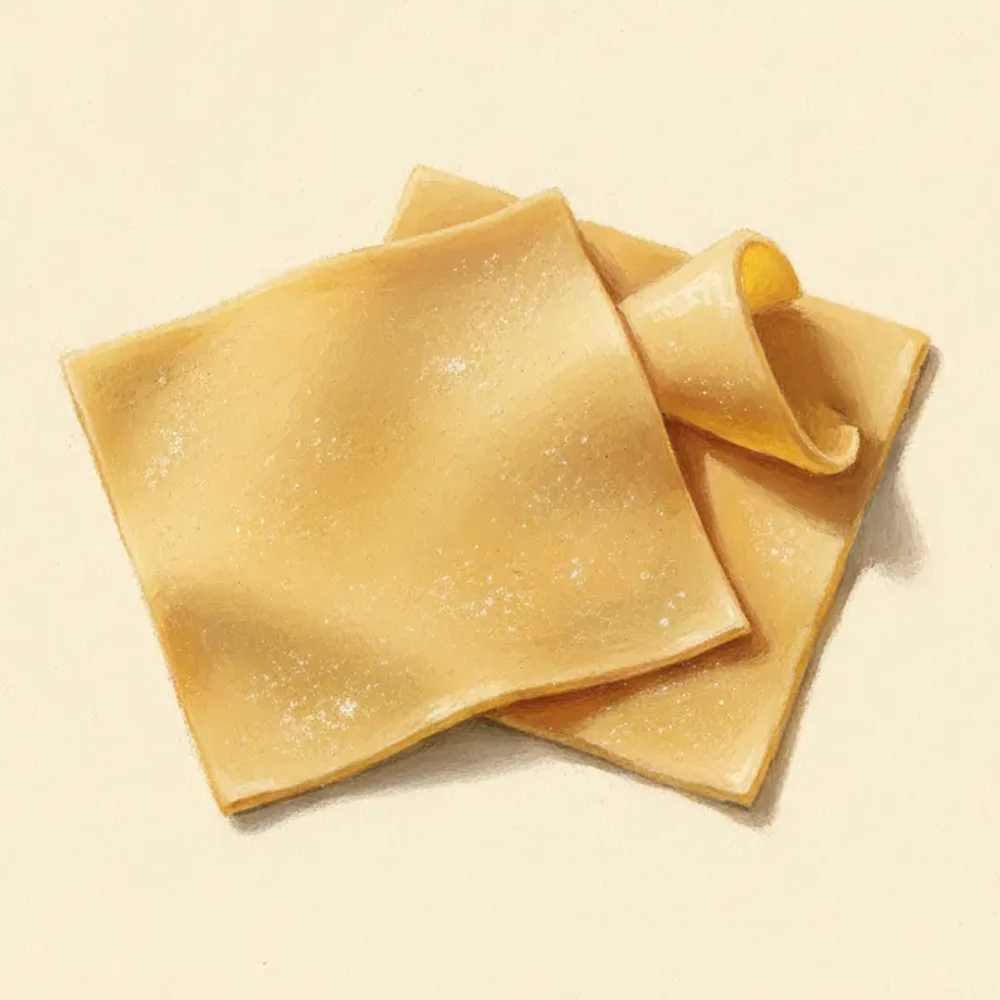
- Pasta for baking: the al forno shapesNot every shape survives the oven. The ones that do are big, sturdy, and built to hold a filling or a sauce.
- A short history of pastaPasta is older than Marco Polo, Italian before it was American, and vegetarian before tomato ever touched it. The real timeline, in six turns.
Stay in the loop
From the Almanac
Updates from Pasta Almanac, when there is something worth sharing.